Modern Rainscreen Systems
in San Jose, CA
Rainscreen Systems Installed by San Jose's Experienced Exterior Wall Contractor c
Free Estimates
Free On-Site Consultations
What Is a Rainscreen System?
A rainscreen system is a wall assembly approach, not a single product. It consists of an outer cladding layer separated from the building’s water-resistive barrier by a defined air cavity. That cavity, typically ranging from 3/8 inch to 2 inches depending on the system and the cladding material, performs two critical functions that cladding installed tight to the substrate cannot.
- Drainage: Any moisture that penetrates the outer cladding layer, whether through joints, fastener penetrations, or capillary action at laps and seams, drains down through the cavity and exits at the base of the wall rather than accumulating against the water-resistive barrier or the sheathing behind it. The cavity provides a physical separation between the wet outer surface and the building structure, and gravity does the rest.
- Drying: The open cavity allows air movement between the outer cladding and the wall behind it. That airflow carries moisture vapor out of the cavity and away from the wall assembly, drying any moisture that has entered rather than allowing it to sit against the sheathing or framing indefinitely. In a tight-against-the-substrate cladding installation, moisture that gets behind the siding has nowhere to go and nothing to accelerate its drying — conditions that produce exactly the kind of sustained wetness that drives wood rot, mold growth, and structural deterioration.
The rainscreen principle is not new — it has been standard practice in Scandinavian and northern European construction for decades, driven by climate conditions far more demanding than San Jose’s. What is relatively new is its adoption as a best practice in California residential and commercial construction, driven by increasing awareness of moisture-related building failures and by building code evolution that now recognizes the performance benefits of ventilated cladding assemblies.
Why Rainscreen Systems Matter in the Bay Area
San Jose’s climate is often described as mild, and in absolute terms it is. But mild does not mean moisture-neutral, and the Bay Area’s specific climate pattern creates exterior wall conditions that make rainscreen assemblies genuinely valuable.
Seasonal Moisture Cycling
San Jose’s Mediterranean climate delivers concentrated moisture during the wet season from November through March, followed by an extended dry period. This cycling pattern creates significant moisture load variation on exterior wall systems. Cladding that gets thoroughly wet during winter storms and then dries slowly because it is installed tight against the substrate accumulates more sustained wetness than the same cladding installed over a ventilated cavity that actively dries it between rain events.
Marine Layer and Condensation
The morning marine layer that moves inland from San Francisco Bay during the warmer months deposits moisture on exterior surfaces even when no rain has fallen. For properties in North San Jose, Alviso, and areas with direct bay exposure, this moisture input is regular and consistent throughout the warm season. A rainscreen cavity allows this surface moisture to dry from both faces rather than being held against the wall by a tight cladding installation.
Temperature-Driven Vapor Movement
The temperature differential between San Jose’s warm summer days and cooler evenings drives vapor movement through exterior wall assemblies. In the absence of a drainage and drying plane, this vapor movement can result in condensation forming within the wall assembly at surfaces that drop below the dew point. A ventilated rainscreen cavity interrupts this cycle by providing a drying path for vapor before it reaches the cold surface where condensation would otherwise form.
Aging Building Stock and Past Moisture Failures
A significant portion of San Jose’s residential building stock was constructed with wall assemblies that had no drainage plane — cladding was installed directly over sheathing with a single layer of felt paper as the only moisture barrier. Many of these buildings have experienced repeated moisture-related failures at windows, doors, and horizontal trim surfaces. When re-cladding these homes, installing a rainscreen assembly is the most effective way to break the cycle of repeated moisture damage rather than simply replacing one tight-against-the-substrate cladding system with another.
Types of Rainscreen Systems We Install
Rainscreen is a wall assembly approach, and it can be executed with a range of cladding materials. The cavity creation method and the cladding product are largely independent choices, which means the rainscreen principle is compatible with most modern exterior cladding materials. Here are the systems we install most frequently for San Jose projects.
Fiber Cement Rainscreen Systems
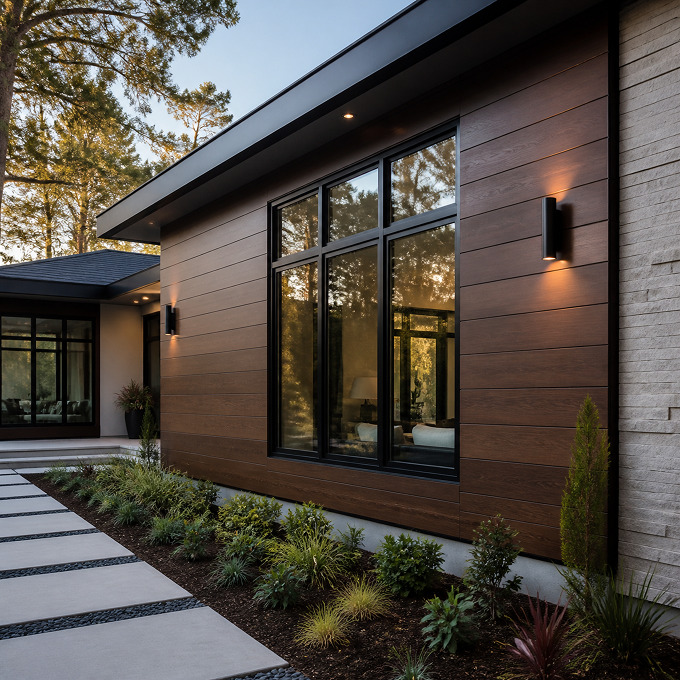
Fiber cement siding, including James Hardie products, is one of the most commonly specified cladding materials in rainscreen assemblies for San Jose residential projects. Fiber cement is installed over a furring strip layer that creates the drainage and drying cavity, with a continuous water-resistive barrier on the sheathing behind the furring. The result is a fiber cement installation that manages moisture significantly better than the same product installed tight to the substrate, with all the durability, fire performance, and low maintenance benefits that fiber cement brings to any installation.
For San Jose homeowners replacing failing stucco or deteriorated wood siding on homes with a history of moisture problems, a fiber cement rainscreen assembly is one of the most effective long-term solutions available.
Composite Wood Rainscreen Systems
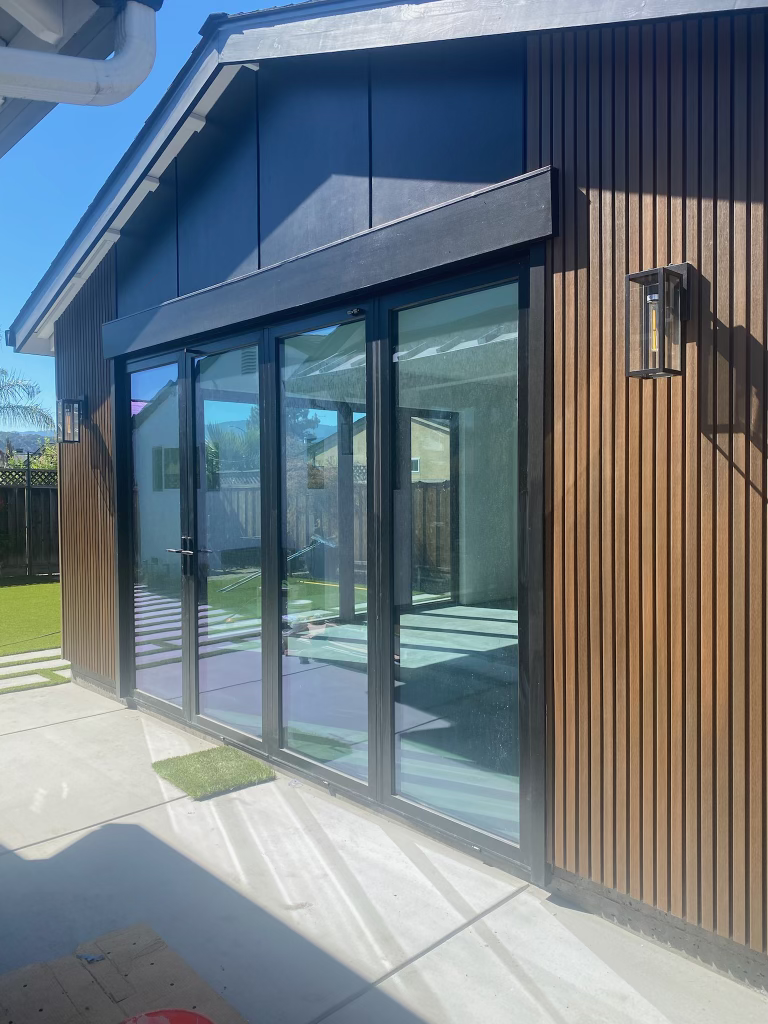
Composite wood cladding installed in a rainscreen assembly combines the natural wood aesthetic that composite products deliver with the moisture management performance of a ventilated cavity. This combination is particularly relevant for wood-look cladding applications on homes in San Jose’s older neighborhoods, where the visual character of wood siding is desired but the site’s moisture history suggests that a tighter wall assembly would continue to produce problems.
Metal Panel Rainscreen Systems
Metal panel cladding — including aluminum panels, ACM panels, and architectural metal systems — is inherently well-suited to rainscreen assembly because most metal panel attachment systems already create a physical separation between the panel back face and the wall behind it. Purpose-designed metal panel rainscreen systems formalize this cavity with specific air gap dimensions and ventilation openings at the top and bottom of the assembly to promote active airflow through the cavity. For commercial buildings in San Jose and Silicon Valley, metal panel rainscreen systems are among the highest-performing exterior wall assemblies available.
Phenolic and HPL Panel Rainscreen Systems
Phenolic resin and high-pressure laminate panels are specifically designed for use in ventilated rainscreen assemblies and are manufactured by most major phenolic panel producers with integrated attachment systems that create a defined cavity as part of the standard installation. These products are widely used in institutional, healthcare, and commercial construction throughout the South Bay, where their chemical resistance, UV stability, and dimensional stability under moisture cycling make them a natural fit for ventilated facade applications.
Wood Siding Rainscreen Systems
Natural wood siding installed in a rainscreen configuration performs significantly better than the same product installed tight to the substrate. The ventilated cavity allows the back face of each board to dry after rain and condensation events, reducing the sustained moisture content that drives rot, paint failure, and dimensional movement in natural wood. For San Jose homeowners committed to natural wood siding, specifying a rainscreen assembly is one of the most effective ways to extend the system’s service life and reduce the maintenance frequency.
Composite and Cementitious Panel Rainscreen Systems
Large-format composite panels, cementitious panels, and other heavy cladding products are frequently installed in back-anchored rainscreen configurations where the panel attachment hardware creates a defined cavity as part of its structural function. These systems are common on commercial, institutional, and multi-family residential buildings throughout San Jose and Silicon Valley and represent some of the highest-specification exterior wall assemblies in the market.
Rainscreen System Components
A correctly designed and installed rainscreen assembly incorporates several components that work together to create a continuous drainage and drying plane behind the cladding.
Water-Resistive Barrier
The water-resistive barrier (WRB) is the innermost moisture management layer in a rainscreen assembly. It is installed over the structural sheathing and is the last line of defense against moisture reaching the framing and insulation. In a rainscreen assembly, the WRB is more important than in a tight cladding installation because it must reliably manage any moisture that drains through the cavity before exiting at the base of the wall.
For rainscreen applications, we specify high-quality WRB products with sealed laps, integrated flashing at all openings and penetrations, and appropriate drainage characteristics. Wrinkled or poorly lapped WRB installation that creates moisture traps behind the furring layer defeats the purpose of the rainscreen cavity.
Furring Strips and Drainage Mats
The cavity in a rainscreen assembly is most commonly created using one of two approaches.
Vertical furring strips are installed over the WRB, perpendicular to the cladding direction, creating a defined air space between the WRB surface and the back face of the cladding. Vertical furring with horizontal cladding creates continuous vertical drainage channels behind the siding. Furring strips are typically 3/4 inch to 1.5 inch in thickness, producing cavity depths in that range. For wood furring in bay-adjacent or high-moisture locations, pressure-treated material or composite furring products are specified.
Drainage mats are three-dimensional polymer mesh products that compress between the WRB and the cladding to create a defined drainage plane without adding the thickness of full furring strips. They are useful in applications where wall thickness is constrained and in transitions where furring strips would be difficult to detail. Drainage mat products are available in thicknesses from 3/8 inch to 3/4 inch.
Ventilation Openings
For a rainscreen cavity to function as a drying plane, it must be ventilated at the top and bottom to allow airflow through the cavity. This requires:
- An open or screened entry at the base of the wall where outside air can enter the cavity
- An open or screened exit at the top of the wall or at intermediate interruptions where warm, moisture-laden air can exit
- Insect screening at all cavity openings to prevent pest entry into the cavity space
Ventilation openings must be maintained throughout the life of the installation. Blocked or sealed cavity openings convert a ventilated rainscreen into a drainage-only system, which is still better than no cavity at all but does not provide the active drying performance of a properly ventilated assembly.
Flashing at Interruptions
Horizontal interruptions in a rainscreen assembly — at windows, doors, floors, and transitions to other wall systems — require specific flashing details that redirect drainage from the cavity to the exterior without allowing water to track behind the WRB. These details are among the most technically demanding aspects of a rainscreen installation and are where inadequate installations most commonly fail.
Free Estimates
Free On-Site Consultations
Rainscreen vs. Traditional Cladding Installation
The difference in moisture management performance between a rainscreen assembly and a tight-to-substrate cladding installation is not a marginal improvement — it is a fundamental change in how the wall system handles the moisture it will inevitably encounter over its service life.
- Traditional tight installation: Water that penetrates the outer cladding contacts the WRB or building paper directly. Any failures or laps in the WRB allow moisture to reach the sheathing. Drying of moisture that has entered the assembly relies entirely on vapor diffusion through the wall layers, which is a slow process. Sustained wetness at the sheathing surface creates conditions for mold growth and rot in wood-framed walls.
- Rainscreen assembly: Water that penetrates the outer cladding enters the cavity and drains down and out at the base. The WRB is protected by the cavity from direct water contact in most conditions. Active airflow through the cavity dries moisture from the WRB surface and the back face of the cladding continuously. The sheathing remains drier over its service life, reducing the risk of moisture-related deterioration.
For San Jose homes with a history of moisture problems at exterior walls, or for new construction and renovation projects where the homeowner or developer wants to avoid those problems entirely, the performance difference is significant.
Rainscreen Systems for Commercial Buildings in San Jose
Commercial buildings in San Jose and Silicon Valley have been specifying ventilated rainscreen facade systems for longer and more consistently than the residential market. The reasons are both performance-driven and specification-driven — commercial architects and building enclosure consultants have understood the performance benefits of ventilated facades for decades, and many commercial cladding products are specifically designed and marketed as rainscreen systems.
For commercial property owners and developers in San Jose, rainscreen assemblies offer advantages beyond moisture management.
Energy performance: Ventilated rainscreen facades create a buffer between the exterior environment and the building’s thermal envelope. In summer, the cavity and cladding intercept solar radiation before it reaches the insulation layer, reducing cooling loads. The performance benefit varies by assembly design and orientation, but it is a recognized advantage of rainscreen construction that is increasingly relevant as California energy codes tighten.
Cladding longevity: Commercial cladding systems on rainscreen assemblies consistently outlast equivalent systems on tight-to-substrate installations. The reduced moisture cycling that a ventilated cavity provides extends the service life of finish coatings, sealants, and substrate materials throughout the assembly. For a commercial property owner making a 30-year building investment, this performance difference has real financial significance.
Code alignment: California’s Title 24 energy code and evolving building enclosure standards increasingly recognize and in some cases incentivize ventilated cladding assemblies. Specifying a rainscreen system from the outset of a commercial project is a forward-looking approach that aligns with the direction building codes are moving.
Our Rainscreen System Installation Process
Rainscreen installation requires more planning and more precise execution at the component level than traditional cladding. Each layer of the assembly depends on the one behind it being correctly installed, and shortcuts at any stage reduce the performance of the complete system.
- On-Site Assessment and Consultation- We visit the property to assess the existing wall assembly condition, identify any substrate damage or moisture issues that need to be addressed before the new assembly goes on, and discuss the cladding material options and cavity creation approach appropriate for the project. This consultation is free with no obligation.
- Assembly Design and Material Specification- Based on the project type, cladding material selection, wall thickness constraints, and site-specific moisture considerations, we specify the WRB product, cavity creation method, furring material, ventilation opening approach, and cladding system. For commercial projects, this coordination typically involves the project architect or building enclosure consultant.
- Permit Application- Rainscreen re-cladding projects in San Jose typically require a building permit, particularly where the WRB system is being replaced, structural sheathing is being repaired, or the wall assembly is being modified. We handle permit coordination and are familiar with the City of San Jose review process for exterior wall system work.
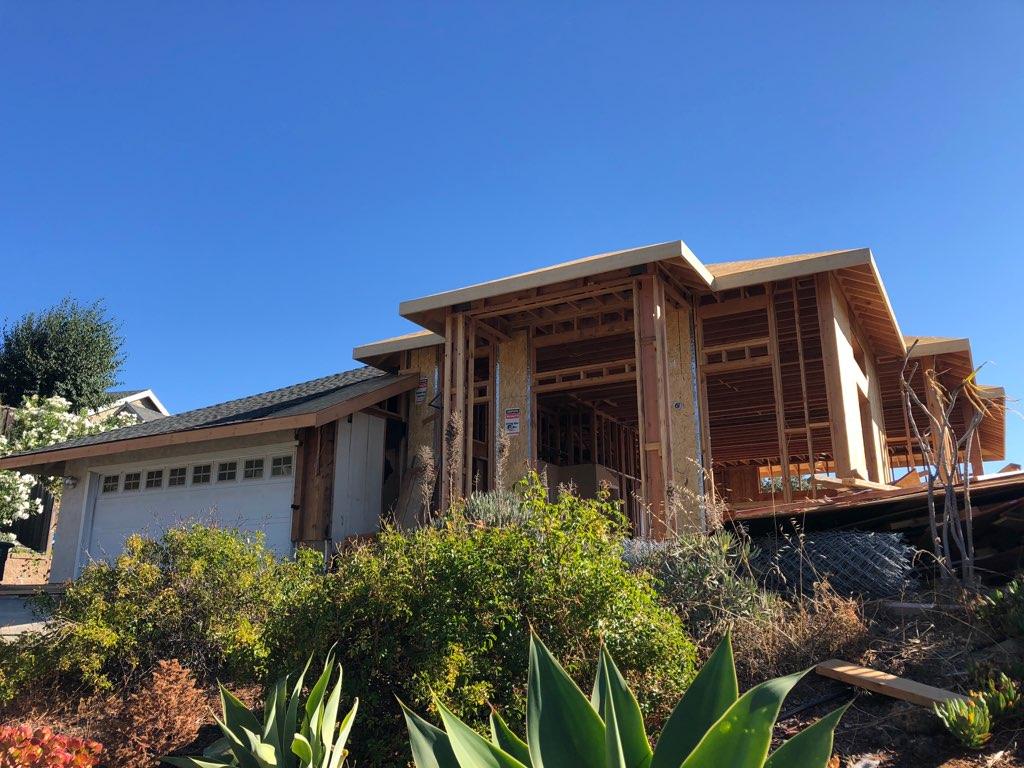
- Existing Cladding Removal and Substrate Inspection- Existing cladding is removed and the full substrate surface is inspected for moisture damage, sheathing condition, and framing integrity. Any damaged sheathing or framing is repaired or replaced before the new assembly components are installed.
- Water-Resistive Barrier Installation- A continuous WRB is installed over the clean sheathing with fully lapped seams, taped joints, and fully integrated flashing at all windows, doors, penetrations, and transitions. This is one of the most critical stages of a rainscreen installation and receives thorough quality review before the furring layer goes on.
- Flashing at All Openings and Interruptions- All window and door openings, horizontal transitions, and wall interruptions receive correctly detailed flashing that integrates with the WRB and directs drainage to the exterior. These details are completed and inspected before furring installation begins.
- Furring Strip or Drainage Mat Installation- Vertical furring strips or drainage mat product is installed over the WRB to create the cavity. Furring is fastened through the WRB into the structural framing at correct spacing for the cladding load being applied. Cavity openings at the base of the wall and at horizontal interruptions are confirmed before cladding installation begins.
- Cladding Installation- The selected cladding material is installed over the furring or drainage mat layer according to the manufacturer’s specifications for that product, with correct fastening through the furring into the structural framing, appropriate overlap or joint dimensions, and correct clearances at the base of the wall.
- Ventilation Opening Screening and Trim- All cavity ventilation openings at the base of the wall, at the top of each story, and at other interruptions are screened with appropriate insect mesh and finished with compatible trim components.
- Final Walkthrough and Inspection- We inspect the completed assembly and walk through the finished work with the client before closing out the scope.
San Jose Neighborhoods and Areas We Serve
We serve residential and commercial clients throughout San Jose and the broader South Bay from our base at 137 E Saint James St. Our primary service area covers a 20-mile radius of San Jose.
San Jose Neighborhoods
- Willow Glen – residential re-cladding projects on homes with moisture histories that benefit from rainscreen assemblies
- Naglee Park and Roosevelt Park – historic character homes being re-clad with moisture-managed assemblies
- Rose Garden – premium residential renovation projects
- Almaden Valley and Blossom Hill – contemporary renovation and new construction
- Cambrian Park and South San Jose – mid-century homes with aging wall assemblies
- North San Jose and Alviso – bay-adjacent properties with elevated moisture exposure
- Downtown San Jose, SoFA District, and Japantown – commercial and mixed-use projects
- East San Jose, Five Wounds, and Olinder neighborhoods
- Berryessa and Northeast San Jose
- Northside, Lakehouse, and Market-Almaden communities
Surrounding Communities
- Saratoga (ZIP 95070) – premium residential and commercial
- Milpitas (ZIP 95035) – residential and commercial, including bay-adjacent locations
- Evergreen and East San Jose (ZIP 95135)
- Los Gatos, Campbell, Santa Clara, Sunnyvale, and Cupertino
- Fremont and other South Bay communities within 20 miles of San Jose
San Jose Neighborhoods and Areas We Serve
We serve residential and commercial clients throughout San Jose and the broader South Bay from our base at 137 E Saint James St. Our primary service area covers a 20-mile radius of San Jose, including all of the following.
San Jose and Silicon Valley Commercial Locations
- Downtown San Jose and the SoFA District – commercial facade renovation and new construction
- North First Street corridor and the Guadalupe River area – tech and mixed-use commercial development
- El Camino Real and Stevens Creek Boulevard – retail and office building facade updates
- Brokaw Road and North San Jose – light industrial and tech campus facilities
- West San Jose and Santana Row area – upscale commercial and mixed-use properties
- East San Jose commercial corridors
Residential Areas
- Willow Glen – contemporary residential renovations and custom infill construction
- Rose Garden and Naglee Park – major renovation projects with contemporary design direction
- Almaden Valley – custom residential and hillside construction
- Cambrian Park and Blossom Hill
- Berryessa, Alviso, and North San Jose
Surrounding Communities
- Saratoga (ZIP 95070) – premium residential and commercial projects
- Milpitas (ZIP 95035) – residential and commercial
- Evergreen and East San Jose (ZIP 95135)
- Los Gatos, Campbell, Santa Clara, Sunnyvale, and Cupertino
- Fremont and other South Bay communities within 20 miles of San Jose
Why Choose San Jose Stucco & Plastering for Modern Rainscreen System Installation
30+ Years of Exterior Wall System Experience- Exterior wall systems are our core business, and that includes a thorough understanding of how moisture behaves in Bay Area wall assemblies. We have seen the results of inadequate moisture management on exterior walls repeatedly over three decades of work in San Jose, and rainscreen assemblies are our recommended approach for projects where that history needs to be corrected.
Full Range of Rainscreen-Compatible Cladding- We install fiber cement, composite wood, metal panels, ACM, phenolic and HPL panels, architectural concrete panels, and natural wood siding in rainscreen configurations. Whatever cladding material is right for your project, we can install it correctly as part of a properly designed rainscreen assembly.
Correct WRB and Flashing Installation- The water-resistive barrier and flashing details are the foundation of any rainscreen assembly. We do not abbreviate this work. Fully lapped and taped WRB seams, correctly detailed flashing at every opening and transition, and sealed fastener penetrations are standard practice on every project we execute.
Commercial and Residential Experience- We work in both commercial construction and residential renovation contexts, coordinating with architects, building enclosure consultants, and general contractors on commercial scopes and working directly with homeowners on residential projects.
Price-Match Guarantee- We will match any competitor’s written estimate. Bring us a written quote from another licensed contractor and we will match it.
Fully Licensed and Insured- All work is performed by our own trained crew under full insurance and California contractor licensing.
Free Estimates and Free On-Site Consultations We do not charge for project assessments or written estimates. We visit the site, assess the existing wall assembly, and give you a thorough, accurate estimate with no obligation.
Frequently Asked Questions About Modern Rainscreen Systems in San Jose
What is the difference between a rainscreen and a standard cladding installation? A standard cladding installation places the siding material directly against the water-resistive barrier on the sheathing with no air space between them. A rainscreen assembly creates a defined air cavity between the cladding and the WRB using furring strips or a drainage mat product. That cavity provides a drainage path for moisture that gets behind the cladding and an airflow path that actively dries the cavity. The practical result is a wall assembly that stays significantly drier over its service life than an equivalent tight-to-substrate installation.
Is a rainscreen assembly required by code in San Jose? Not universally, but California’s building codes have been evolving in a direction that increasingly recognizes and incentivizes ventilated cladding assemblies. Some cladding materials, particularly fiber cement products, have manufacturer installation guidelines that specify or recommend a drainage gap that functions as a simplified rainscreen. For commercial projects with specific energy code compliance paths, ventilated assemblies may provide compliance credit. Regardless of code requirements, we recommend rainscreen assemblies on projects where moisture management is a concern.
Does a rainscreen assembly add significant thickness to the exterior wall? Yes, modestly. A standard furring strip rainscreen adds 3/4 inch to 1.5 inches to the wall thickness depending on the furring depth. Drainage mat products add 3/8 inch to 3/4 inch. This added thickness needs to be accounted for at window and door jamb extensions and at transitions to adjacent wall surfaces. It is a manageable detail in both new construction and renovation contexts, and we address it as part of the project planning process.
What cladding materials can be installed in a rainscreen assembly? Most modern exterior cladding materials are compatible with rainscreen installation, including fiber cement, composite wood, natural wood, metal panels, ACM, phenolic and HPL panels, architectural concrete panels, and various composite panel products. The cavity creation method and furring specification may vary depending on the cladding weight and attachment requirements, but the rainscreen principle is applicable across virtually all of the cladding systems we install.
How does a rainscreen system affect energy performance? A ventilated rainscreen facade creates a buffer zone between the exterior cladding and the building’s insulation layer. In summer, the cladding and cavity intercept solar heat before it reaches the insulation, reducing the cooling load on the building. The performance benefit depends on the assembly design, orientation, and local climate conditions. In San Jose’s climate, the cooling season benefit is more significant than the heating season impact, and south and west-facing elevations see the greatest energy performance improvement from ventilated cladding.
Can a rainscreen assembly be added to an existing building during re-cladding? Yes, and this is one of the most valuable applications of rainscreen technology. When re-cladding an existing building, adding a rainscreen assembly as part of the scope requires removing the existing cladding, which is already necessary, and adding furring strips or a drainage mat before the new cladding goes on. The incremental cost of the furring material and its installation is modest relative to the total project cost, and the moisture management benefit over the life of the new cladding is significant. For buildings with a history of moisture problems at exterior walls, adding a rainscreen assembly during re-cladding is one of the most cost-effective improvements available.
How is the base of a rainscreen cavity detailed to prevent pest entry? The cavity ventilation opening at the base of the wall is covered with a corrosion-resistant insect screen that allows airflow while preventing insects, birds, and rodents from entering the cavity. The screen is typically integrated with a vented base trim piece that also directs any drainage from the cavity to the exterior. Pest exclusion at cavity openings is an important detail that we address on every rainscreen installation.
Does a rainscreen system affect the installation of windows and doors? Yes, because the added wall thickness from the furring layer means that window and door jambs need to be extended to flush with the new cladding face. For new construction, this is accommodated in the window specification. For renovation projects, existing windows may need jamb extension trim to bring them flush with the new cladding plane. We identify all jamb extension requirements during the project assessment and include them in the project scope.
Get a Free Estimate for
Modern Rainscreen System Installation in San Jose