Metal Siding & Facade Systems
in San Jose, CA
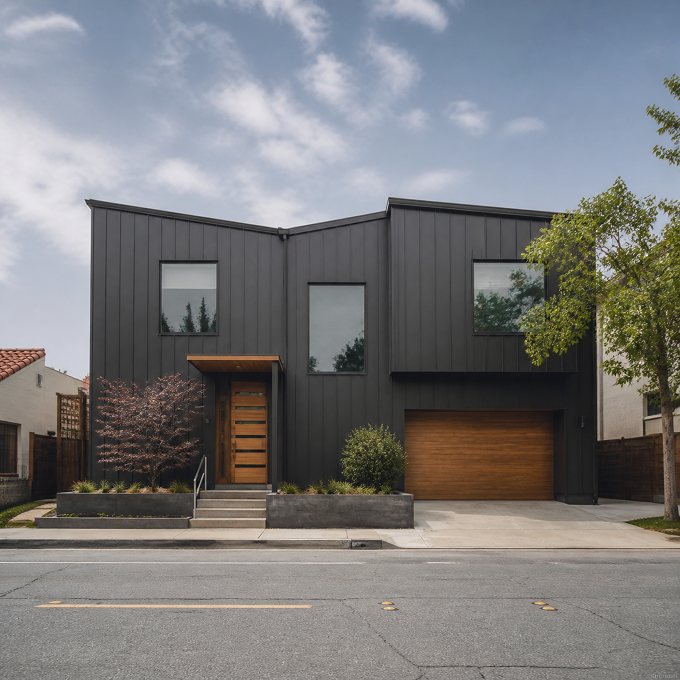
Durable, non-combustible, and architecturally precise — metal siding and facade systems installed by San Jose's experienced exterior cladding contractor.
Free Estimates
Free On-Site Consultations
Why Metal Siding and Facade Systems Are Widely Specified in San Jose
The South Bay’s architectural landscape has a strong affinity for metal facade systems. The combination of contemporary design culture in Silicon Valley, a climate that is relatively favorable to metal cladding performance, and a regulatory environment that increasingly favors non-combustible exterior materials has created consistent, broad demand for metal siding and facade systems across a wide range of project types.
Non-Combustibility
Metal cladding is inherently non-combustible. Steel, aluminum, zinc, and copper do not contribute fuel to a fire, and metal panel systems carry Class A fire ratings that satisfy California Building Code requirements for exterior cladding on buildings of virtually any construction type and height. For properties in Very High Fire Hazard Severity Zones in Santa Clara County, including foothill areas of San Jose, Los Gatos, and communities bordering open space, non-combustible metal cladding is not only a code-compliant choice but a genuinely protective one.
Long Service Life
Metal cladding systems, when correctly specified and installed, have service lives that most other exterior materials cannot match. Properly coated steel and aluminum panels resist weathering and surface degradation for decades in California’s climate. Zinc and copper systems develop protective patinas that provide ongoing corrosion resistance essentially indefinitely. The long-term economics of metal cladding, accounting for reduced maintenance, longer repaint intervals, and extended service life, are genuinely compelling for both commercial and residential property owners making long-term investment decisions about their buildings.
Design Range
Metal cladding is available in profile configurations, surface finishes, colors, and custom fabrication options that give designers and property owners a degree of creative control that is difficult to match with other materials. A corrugated steel panel and a precision-folded flat aluminum panel system are both metal cladding, but they produce entirely different architectural results. The ability to specify metal in profiles that range from agricultural simplicity to refined commercial precision, in finishes that span from raw weathering steel to high-gloss anodized aluminum, gives metal a design versatility that few other exterior materials offer.
Lightweight Construction
Metal cladding panels are among the lightest exterior cladding materials available relative to their surface coverage and structural performance. This weight advantage simplifies the structural assessment for renovation projects where additional cladding load is a concern, reduces the size and complexity of the attachment system, and makes installation more efficient on projects where access or schedule is constrained.
Low Maintenance
Factory-applied coatings on steel and aluminum metal cladding systems, particularly PVDF-finished products, require minimal ongoing maintenance under normal exposure conditions in San Jose’s climate. Periodic washing to remove surface deposits is the primary maintenance task for most metal siding installations. The absence of a repainting cycle that wood-based and cement-based cladding systems require is a practical advantage that metal cladding delivers consistently over its service life.
Metal Siding and Facade Products We Install
Standing Seam Metal Panels
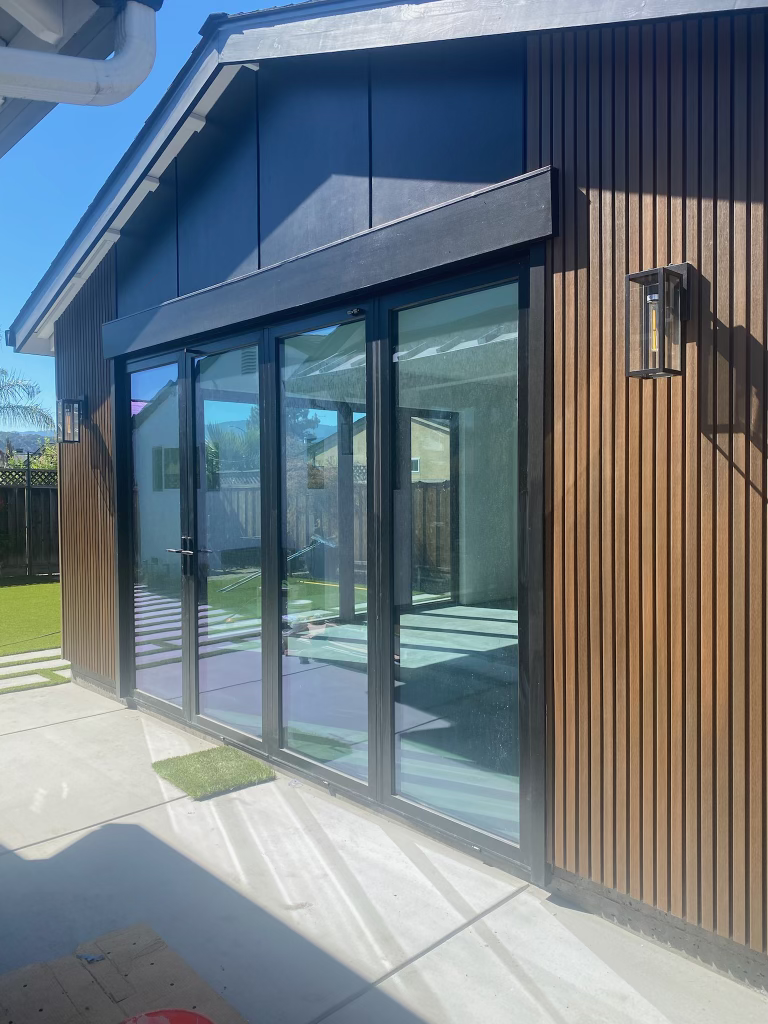
Standing seam is the metal panel profile most closely associated with contemporary architectural design, and it is one of the most widely specified metal cladding configurations for both commercial and residential projects throughout the South Bay.
Standing seam panels are formed from coiled metal sheet with raised interlocking seams running vertically along the panel length. The seams connect adjacent panels without exposed fasteners, creating a clean, uninterrupted surface with a strong linear profile that produces dramatic shadow lines on facade applications. The concealed fastener system means that no fastener penetrates the panel face, which eliminates the potential for water infiltration at fastener locations and contributes to the system’s long-term weather performance.
Standing seam metal cladding is available in steel, aluminum, zinc, and copper substrates, in factory-applied paint finishes or natural metal finishes, and in panel widths typically ranging from 12 inches to 24 inches. For contemporary residential projects in Willow Glen, Almaden Valley, and the Rose Garden area, standing seam metal accents on gable ends, garage facades, and entry features are among the most requested metal cladding applications we handle. For commercial construction, standing seam facade systems are used extensively on tech campus buildings, healthcare facilities, and contemporary office construction throughout the North First Street corridor and the broader Silicon Valley commercial market.
Corrugated and Ribbed Metal Panels
Corrugated and ribbed metal panel profiles have undergone a significant architectural repositioning over the past two decades. Once associated primarily with agricultural and industrial construction, these profiles are now widely specified in contemporary design for their bold texture, honest material expression, and practical cost efficiency relative to more fabrication-intensive panel systems.
Corrugated metal siding in pre-painted or bare steel, aluminum, and Cor-Ten weathering steel finishes is used on residential renovation projects, ADU construction, retail storefronts, and commercial facade applications throughout San Jose. The profile’s strong shadow line at each ridge and valley creates visual depth on a building facade that flat panel systems do not produce, and its association with industrial and rural architectural character makes it a natural fit for contemporary farmhouse, industrial-modern, and warehouse-conversion aesthetic directions that are common in renovation projects across the South Bay.
Ribbed metal panels, which use a shallower and more regular profile than traditional corrugation, are used for commercial and residential applications where some of the texture of corrugated metal is desired with a more refined, controlled appearance.
Flat Metal Panel Systems
Flat metal cladding panels, fabricated from aluminum, steel, zinc, or copper in custom dimensions and finished with PVDF coatings, anodized finishes, or natural metal surfaces, are used for high-specification commercial and residential facade applications where a precise, planar surface without the profile of standing seam or corrugation is the design intent.
Flat panel systems require more precise fabrication than profiled products because any dimensional inconsistency or surface irregularity is immediately visible on a flat plane. They are installed using concealed or visible attachment systems that incorporate the thermal expansion capacity flat panels require, and they are detailed at joints, corners, and transitions with aluminum extrusion profiles that maintain the clean surface quality of the panel field.
For commercial building facades throughout downtown San Jose and the Silicon Valley tech campus corridor, flat metal panel systems are used in combination with glass curtainwall systems, ACM panels, and other facade components as part of complex multi-material facade compositions.
Cor-Ten Weathering Steel
Cor-Ten and similar weathering steel alloys develop a stable rust-like patina through controlled atmospheric oxidation that passivates the surface and prevents the ongoing corrosion that would affect unalloyed steel under the same conditions. The resulting surface appearance, a rich range of warm orange and brown tones that evolve over the first few years of exposure before stabilizing, is specific to this material and cannot be convincingly replicated by applied coatings on other substrates.
Weathering steel cladding is used on contemporary residential projects, restaurant and retail storefronts, and feature wall applications throughout San Jose where the material’s distinctive and evolving appearance is the specific design intent. It is important to note that weathering steel requires specific detailing at the base of the wall and at drainage points to prevent the initial rust runoff that occurs during the patina development phase from staining adjacent surfaces. We address these detailing requirements explicitly on every weathering steel project.
Zinc Cladding Systems
Architectural zinc cladding, including products from manufacturers like RHEINZINK and VM Zinc, provides a premium natural metal facade finish with a long service life and a distinctive gray-blue patina that develops gradually under natural exposure. Zinc is a self-healing material in the sense that minor surface scratches are covered by the ongoing patina development process rather than remaining as permanent marks.
Zinc cladding is available in standing seam, flat panel, shingle, and interlocking tile profiles, as well as pre-weathered finishes that accelerate the natural patina to a stable gray tone at the time of installation rather than over several years of exposure. For residential projects in San Jose where a premium natural metal facade is specified, zinc cladding delivers a material depth and character that painted aluminum and coated steel products cannot replicate.
Copper Cladding Systems
Copper is among the most historically enduring architectural metal cladding materials, and its use in contemporary architectural applications continues on premium residential and institutional projects where the material’s distinctive natural patina and essentially indefinite service life are the specific qualities sought. Copper cladding develops from its initial bright natural tone through a series of intermediate brown and gray states before reaching the familiar green patina in environments with sufficient moisture and atmospheric chemistry to complete the transformation.
For high-end residential projects in San Jose’s premium residential market, copper cladding on specific facade elements, bay windows, tower features, and entry details is a statement of material quality and permanence that few other materials convey.
Perforated Metal Screens and Sunshades
Perforated metal panels are used for facade screening, solar shading, privacy screens, and decorative facade layers on commercial and residential buildings throughout San Jose. They are fabricated from aluminum or steel sheet with punched perforation patterns in standard or custom configurations and are installed as a secondary facade layer over a primary cladding system or as standalone screening elements.
For commercial buildings in San Jose where solar heat gain on south and west-facing elevations is a performance concern, perforated metal sunshades and brise-soleil screens provide a practical and architecturally expressive way to reduce solar loading on the building envelope while maintaining facade interest and visual connection between interior and exterior. We install perforated metal screen systems as standalone facade elements and in combination with other metal and non-metal cladding systems.
Metal Soffit and Fascia Systems
Architectural metal soffit and fascia systems are used on commercial building overhangs, entry canopies, covered walkways, and parking structure ceilings throughout San Jose. Metal soffit panels in aluminum with PVDF finishes are a consistent specification for these applications because of their moisture resistance, low maintenance, and availability in the light-reflective colors that are typically specified for exterior ceiling applications. We install metal soffit and fascia systems as standalone scopes and as integrated components of complete metal facade projects.
Metal Substrate Options and Their Characteristics
Selecting the appropriate metal substrate for a given project is one of the first and most consequential decisions in any metal cladding specification. Different substrates have different weight, cost, corrosion resistance, fabricability, and design character, and matching the substrate to the project’s specific requirements produces better long-term results than defaulting to a single material across all applications.
Aluminum
Aluminum is the most widely used substrate for architectural metal panel cladding in California. It is lightweight, inherently corrosion-resistant through natural oxide formation, compatible with a wide range of factory-applied finishes, and highly fabricable into complex profiles and custom shapes. For commercial facade projects, retail storefronts, and residential accent applications throughout San Jose, aluminum is the default substrate specification for most flat panel, standing seam, and custom profile applications.
Galvanized and Galvalume Steel
Galvanized steel provides corrosion resistance through a zinc coating applied to the steel substrate. Galvalume steel uses a zinc-aluminum alloy coating that provides somewhat better corrosion performance than standard galvanization. These products are commonly used for corrugated and ribbed panel applications and for pre-painted steel siding systems. Correctly specified pre-painted galvanized and Galvalume steel siding performs well in San Jose’s inland climate, though enhanced specifications are appropriate for bay-adjacent and higher-humidity locations.
Stainless Steel
Stainless steel cladding, particularly grade 316 for marine-adjacent applications, provides the highest level of corrosion resistance of any common architectural metal substrate. It is used for specific applications where corrosion performance cannot be compromised, for premium commercial facades where the material’s bright, precise surface character is the design intent, and for bay-adjacent properties in North San Jose and Alviso where standard steel and aluminum specifications may not provide adequate corrosion resistance.
Zinc
Architectural zinc, distinct from the galvanizing zinc coating on steel, is used as a primary facade substrate in standing seam, flat panel, and shingle profiles. It is self-healing under atmospheric exposure, forms a stable protective patina, and has a service life measured in generations on correctly installed and detailed installations.
Copper
Copper is used as a primary facade substrate on premium residential and institutional applications. Its extraordinary service life, natural patina development, and material warmth make it a unique architectural specification that no other metal substrate replicates.
Finishes and Coatings for Metal Cladding
PVDF (Kynar) Coatings
PVDF coatings are the industry standard for factory-applied finishes on steel and aluminum architectural panels. Their UV resistance, color stability, and resistance to chalking and fading under California’s sun-intensive exterior conditions make them the appropriate finish specification for the majority of metal cladding applications in San Jose. Most PVDF finish warranties run 10 to 20 years against chalking and fading, and real-world performance in California’s climate consistently meets or exceeds those terms.
Anodized Aluminum
Anodizing converts the aluminum surface to an integrated oxide layer rather than applying a separate coating. The result is a finish with metallic depth and stability that painted finishes do not replicate, and a surface that cannot peel, chip, or delaminate because it is part of the substrate rather than applied to it. Anodized finishes are available in clear, champagne, bronze, and dark bronze architectural tones and are frequently specified for premium commercial and residential metal cladding applications throughout San Jose and Silicon Valley.
Powder Coat
Polyester powder coat finishes provide good color uniformity and a wide color range at lower cost than PVDF. They are appropriate for sheltered applications, secondary facade elements, and projects where the cost differential relative to PVDF is a significant project constraint. For primary exterior metal cladding on south and west-facing elevations in San Jose, PVDF is generally the more appropriate specification for long-term color retention.
Natural and Pre-Weathered Finishes
Cor-Ten weathering steel, architectural zinc, and copper are used in natural finish configurations where the material’s inherent weathering character is the design intent. Pre-weathered zinc products provide a stable, consistent gray tone at installation rather than requiring the building owner to manage the active weathering phase in the field.
Free Estimates
Free On-Site Consultations
Signs a Building Is Ready for Metal Siding or Facade Cladding
Commercial Buildings
- An existing facade finish that is dated, deteriorated, or no longer consistent with the building’s market position or brand
- An existing metal cladding system whose finish has faded significantly or whose substrate has developed corrosion that cannot be cost-effectively addressed
- A building being repositioned in the leasing market where updated contemporary exterior finishes are part of the improvement strategy
- New commercial construction where metal cladding is specified as part of a contemporary or industrial-modern facade composition
- A fire code compliance requirement that drives the selection of non-combustible exterior cladding
Residential Projects
- A custom home or major renovation where the architect has specified metal siding as part of a contemporary, industrial, or farmhouse exterior composition
- A garage facade, gable end, entry feature, or accent elevation where a metal panel is specified as a design accent to a primary stucco or fiber cement exterior
- An ADU construction project where corrugated or standing seam metal siding provides a cost-effective, durable, and architecturally coherent exterior finish
- A property in a fire hazard severity zone where non-combustible cladding is required or preferred
Our Metal Siding and Facade System Installation Process
Metal siding and facade installation requires precise layout work, correct substrate and moisture management execution, appropriate attachment system installation for the specific panel type, and careful attention to thermal movement accommodation at joints, corners, and transitions.
- On-Site Assessment and Consultation- We visit the property to assess the existing substrate condition, building geometry, site access, and any conditions requiring attention before installation begins. For commercial projects, we review available drawings and coordinate with the project team on scope, schedule, and product specification. This consultation is free with no obligation.
- Material and System Specification- Based on the project requirements, we advise on the appropriate metal substrate, profile, finish, panel dimensions, and attachment system. For projects where an architect has specified a product, we work from that specification. For projects where specification is still being developed, we contribute product knowledge and installation perspective to support the decision-making process.
- Permit Application- Metal siding and facade installations on commercial buildings in San Jose require building permits. For residential projects, permit requirements depend on the scope of work. We handle permit coordination and are familiar with the City of San Jose review process.
- Substrate Preparation and WRB Installation- Existing substrate conditions are assessed and any damaged or moisture-affected sheathing is repaired or replaced. A continuous WRB is installed over the clean substrate with fully lapped and taped seams, integrated flashing at all openings and penetrations, and correctly sealed fastener locations.
- Flashing at All Openings and Transitions- Correctly detailed flashing is installed at every window opening, door opening, horizontal transition, and material interface before any metal panel work begins. Metal-to-substrate transitions, metal-to-glass interfaces, and metal-to-other-cladding transitions all require specific flashing details that we execute according to the project drawings and applicable code requirements.
- Attachment System Installation- The appropriate attachment system for the specific metal panel type, whether concealed clip for standing seam, rail and bracket for flat panels, or direct fastening for corrugated profiles, is installed with precise layout from control lines established across the building face. Thermal expansion provisions are incorporated at this stage in the layout, particularly for large flat panel systems where thermal movement across the full installation area needs to be accommodated without buckling or joint failure.
- Metal Panel Installation- Panels are installed in the sequence appropriate for the specific panel system, with consistent joint widths, correct lap dimensions, and alignment maintained continuously against the control lines. Thermal expansion gaps at butt joints and perimeter conditions are maintained according to the panel manufacturer’s requirements and the calculated movement range for the installation area.
- Trim, Corner, and Transition Details- Corner trim, transition extrusions, window and door surrounds, base flashings, and top-of-wall conditions are installed with the same precision as the field panel work. All interfaces between metal cladding and adjacent materials, whether glass, masonry, stucco, or other panel systems, receive correct flashing and sealant treatment.
- Sealant Application- Where sealant is specified at joints, transitions, and penetrations, it is applied to the manufacturer’s requirements for surface preparation, backer rod placement, joint geometry, and cure conditions. Sealant colors are matched or complementary to the metal panel finish.
- Final Inspection and Walkthrough- We inspect the completed installation against the project specification, confirm that all thermal expansion provisions are correctly incorporated, and walk through the finished work with the client or project team before closing out the scope.
Metal Siding Maintenance
Metal cladding systems are among the lowest-maintenance exterior products available, but they are not completely maintenance-free.
Surface washing: Factory-finished metal panels should be washed periodically to remove surface deposits, pollution film, and in bay-adjacent locations, salt accumulation. Washing from the top of the building downward with fresh water and a mild detergent is appropriate. High-pressure washing should be avoided on panels with applied coatings.
Sealant inspection: Sealant at joints, transitions, and penetrations should be inspected annually and resealed wherever cracking, adhesion loss, or compression set is identified.
Fastener and hardware inspection: Exposed fasteners and attachment hardware should be inspected for corrosion, particularly on galvanized steel systems in higher-humidity locations and on any installation following a significant seismic event.
Touch-up of coating damage: Scratches and chips in factory-applied finishes should be addressed with compatible touch-up products to prevent corrosion initiation at the damaged location. For PVDF-finished products, manufacturer-supplied touch-up paints are available in matched colors.
Weathering steel management: During the patina development phase of Cor-Ten and weathering steel installations, runoff from the developing rust patina will stain adjacent surfaces if they are not protected or drained away from the building. Monitoring drainage conditions during the first two to three years after installation and cleaning stained surfaces as needed is part of managing a weathering steel cladding system through its initial weathering phase.
San Jose Neighborhoods and Areas We Serve
We serve residential and commercial clients throughout San Jose and the broader South Bay from our base at 137 E Saint James St. Our primary service area covers a 20-mile radius of San Jose.
San Jose and Silicon Valley Commercial Locations
- Downtown San Jose and the SoFA District – commercial facade renovation and new construction
- North First Street corridor – tech campus, office, and research facility buildings
- El Camino Real and Stevens Creek Boulevard – retail, commercial, and medical office facade projects
- Brokaw Road and North San Jose – light industrial, tech campus, and healthcare facilities
- Santana Row area and West San Jose – upscale retail, hospitality, and mixed-use properties
- East San Jose commercial corridors
- Japantown and surrounding downtown neighborhoods
Residential Areas
- Willow Glen – standing seam metal accents and contemporary residential renovation
- Rose Garden and Naglee Park – major renovation projects incorporating metal facade elements
- Almaden Valley – custom residential construction and hillside projects
- Cambrian Park, Blossom Hill, and South San Jose
- Berryessa, Alviso, and North San Jose – including anti-corrosion specifications for bay-adjacent properties
- Northside, Lakehouse, and Market-Almaden communities
Surrounding Communities
- Saratoga (ZIP 95070) – premium residential metal cladding and commercial projects
- Milpitas (ZIP 95035) – residential and commercial
- Evergreen and East San Jose (ZIP 95135)
- Los Gatos, Campbell, Santa Clara, Sunnyvale, and Cupertino
- Fremont and other South Bay communities within 20 miles of San Jose
Why Choose San Jose Stucco & Plastering for Metal Siding and Facade Systems
30+ Years of Exterior Wall System Experience- Exterior wall systems are the core of our business. That experience includes direct familiarity with how metal cladding performs across San Jose’s range of microclimates, building types, and design contexts, and with the substrate preparation, moisture management, and thermal movement accommodation details that determine whether a metal facade performs correctly over its service life.
Full Range of Metal Cladding Products- We install standing seam panels, corrugated and ribbed metal profiles, flat panel systems, weathering steel, zinc, copper, perforated metal screens, and metal soffit and fascia systems. That breadth means we can honestly assess which metal system is appropriate for a given project rather than defaulting to whatever one product we are most familiar with.
Thermal Movement Expertise- Metal cladding expands and contracts more than most other cladding materials under temperature cycling, and accommodating that movement correctly in the joint design and attachment system is essential to long-term performance. We design thermal movement provisions into every metal cladding installation from the outset, not as an afterthought.
Full-Service Exterior Contractor- Beyond metal siding and facade systems, we install fiber cement, composite wood, ACM panels, phenolic and HPL systems, architectural concrete panels, rainscreen assemblies, and stucco. Projects that combine metal cladding with other systems are handled entirely by our crew, including all transitions between materials.
Price-Match Guarantee- We will match any competitor’s written estimate. Bring us a written quote from another licensed contractor and we will match it.
Fully Licensed and Insured- All work is performed by our own trained crew under full insurance and California contractor licensing.
Free Estimates and Free On-Site Consultations- We do not charge for project assessments or written estimates. We visit the site, assess the project requirements, and give you a thorough, accurate estimate with no obligation.
Frequently Asked Questions About Metal Siding and Facade Systems in San Jose
What is the most common metal siding profile used on San Jose homes? Standing seam metal panels and corrugated metal siding are the two most common profiles on residential projects in San Jose. Standing seam is favored for contemporary and modern residential renovations where a clean, precise facade profile is the design intent, particularly as accent cladding on gable ends, garage facades, and entry features. Corrugated metal is favored for contemporary farmhouse, industrial-modern, and ADU applications where a bolder textural profile is appropriate. The right choice depends on the architectural direction of the specific project.
How does metal siding perform in fire hazard areas of San Jose? Metal cladding is inherently non-combustible and carries Class A fire ratings that satisfy California Building Code requirements for exterior cladding in Very High Fire Hazard Severity Zones. For properties in foothill areas of San Jose, Los Gatos, and Santa Clara County communities bordering open space where non-combustible exterior cladding is required or strongly advisable, metal siding and facade systems are among the most straightforward code-compliant specifications available.
Does metal siding expand and contract significantly in San Jose’s climate? Yes. Metal cladding has a higher coefficient of thermal expansion than most other cladding materials, and Bay Area temperature cycling, including the significant diurnal temperature variation San Jose experiences in summer months, produces meaningful dimensional movement in metal panel systems over the course of a day. Correctly designed attachment systems and joint details accommodate this movement without panel buckling, fastener pullout, or joint failure. Installations that do not account for thermal movement are among the most common causes of premature metal cladding failures, and it is a detail we address explicitly on every project.
What is the difference between standing seam and flat metal panel systems? Standing seam panels have raised interlocking seams running vertically along the panel length that connect adjacent panels without exposed fasteners. The seams create a strong linear profile on the facade and provide the concealed fastener system that gives standing seam installations their clean appearance and weather performance. Flat metal panels are installed with essentially flush surfaces and no raised profile, using concealed clip systems that allow thermal movement while maintaining the planar quality of the facade. Flat panel systems are more fabrication-intensive and more demanding to install precisely than standing seam profiles but produce a different architectural character suited to specific design directions.
Can metal siding be installed on an existing building without removing the current cladding? In some cases, but we generally recommend removing the existing cladding to inspect the substrate condition, replace any moisture-damaged sheathing, and install a fresh WRB and correctly detailed flashing before metal panels go on. Installing metal cladding over an unassessed substrate with an unknown WRB condition introduces risk that the new metal system will perform well on the outside while moisture problems continue to develop behind it. We evaluate each project’s specific circumstances during the consultation and give an honest recommendation on whether over-installation is appropriate.
How long does metal siding installation take? Duration depends on the panel system, the building size, the complexity of the facade geometry, and the extent of any substrate repair. A residential accent or feature elevation in standing seam metal can typically be completed in a few days to a week. A complete residential re-cladding in metal siding typically runs one to two weeks. Commercial facade projects vary widely based on scale and system complexity, and we provide realistic schedule estimates during the initial project consultation.
Do you install metal siding on ADUs and secondary structures? Yes. Corrugated metal, standing seam panels, and pre-painted steel siding systems are all practical and commonly specified options for ADU construction throughout San Jose. Metal siding is a cost-effective, durable, and fire-safe choice for secondary structures, and it installs efficiently on the relatively straightforward geometry of most ADU construction. We handle metal siding installation on ADU projects directly, often as part of a broader exterior scope that includes the primary residence.
Get a Free Estimate for Metal Siding and Facade Systems in San Jose